 |
|
DCR to De-List White Heath Aster and Hairy Beardtongue from Rare Species Status
WSSI Scientists Discover and Document Hundreds of "Rare" Plants
|
 |
| Figure 1. White Heath Aster (Symphyotrichum ericoides) |
The Virginia Department of Conservation and Recreation Division of Natural Heritage (DCR) has identified eight rare plant species associated with soils derived from diabase rock (a calcium rich, volcanic-based rock) in the Culpeper Basin of Northern Virginia. These species are: hairy beardtongue (Penstemon hirsutus), earleaf foxglove (Agalinis auriculata), white heath aster (Symphyotrichum ericoides), blue-hearts (Buchnera Americana), downy phlox (Phlox pilosa), stiff goldenrod (Oligoneuron rigidum var. rigidum), marsh hedgenettle (Stachys pilosa var. arenicola), and purple milkweed (Asclepias purpurescens). None of these species are listed as endangered or threatened at either the state or Federal level and, therefore, not legally protected by state or Federal statutes. But because all of these species are considered rare by DCR, the department tracks their occurrences in the state.
At the local level, jurisdictions can require surveys for DCR-tracked species. As part of its rezoning requirements under its Revised General Plan (pp. 5-32 and 5-33) and Facilities Standards Manual (Section 7.700 A), Loudoun County can require surveys for these species. In certain instances, Loudoun County has required developers to avoid any rare species detected on a site or to relocate individuals of these species from proposed impact areas to areas of suitable habitat that will not be disturbed by project development.
In Impact Review letters for development projects in the region, DCR has mentioned the possible occurrence of these “rare” diabase-associated plant species on sites that have suitable habitat and diabase soils. High-quality suitable habitat for these species generally consists of open or semi-open areas with diabase-derived soils and a mixture of Indian grass (Sorghastrum nutans) and little bluestem (Schizachyrium scoparium) with a diverse mixture of native forbs (broad-leaved herbs other than a grass) and few, if any, non-native grasses. Because of their rather specialized habitat requirements, these species generally have restricted distributions in Virginia and/or occur in only relatively small numbers; and, therefore, are considered "rare" by DCR.
In the course of performing wetland delineation field work and endangered and threatened species (ETS) habitat evaluations throughout Northern Virginia, environmental scientists from Wetland Studies and Solutions, Inc. (WSSI) have recorded two of these “rare” plant species, white heath aster (Figure 1) and hairy beardtongue (Figure 2), at a number of previously unknown stations.
In February 2004, WSSI provided DCR with generalized locality information describing additional white heath aster occurrences discovered by WSSI staff. These additional occurrences comprise hundreds of plants located at dozens of stations located in Loudoun, Fairfax, Prince William and Fauquier Counties. On October 13, 2004, WSSI staff met with John Townsend, a DCR Staff Botanist, to visit these white heath aster stations to demonstrate that this species is not as rare as previously thought. During the site visit, literally hundreds of white heath asters were observed, primarily along the Braddock Road and Route 50 corridors in western Fairfax County and eastern Loudoun County. Large numbers of white heath asters were observed along disturbed road sides, within utility easements, and on spoil piles as well as in areas exhibiting characteristics of high-quality habitat for the rare diabase-associated plant species.
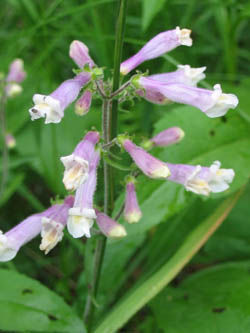 |
| Figure 2. Hairy Beardtongue (Penstemon hirsutus) |
Based on observations made during the October 2004 site visits, and as confirmed in a February 1, 2005 email correspondence from John Townsend, DCR plans to remove the white heath aster from the list of rare species for which it recommends surveys due to its weedy tendencies and the additional number of occurrences now known in the state. DCR also plans to remove hairy beardtongue from this list for similar reasons.
Both of these “de-listings” will become official when the revised rare plant list is published, expected sometime in March 2005.
Although these species are proposed to be “de-listed”, DCR notes that both species still have very restricted distributions in Virginia. As the numbers and distributions of these species become further reduced by increased development pressures, both species could be re-listed at some point in the future.
|
|
 |
|