 |
|
Endangered and Threatened Species Alert: Small Whorled Pogonia
|
 |
| Small Whorled Pogonia |
If you
are planning to develop property in Northern Virginia having
mature hardwood forest with an open understory, you will most
likely need a survey for the small whorled pogonia (Isotria
medeoloides) between June 1 and July 20—or your wetlands
permitting may be delayed up to a year!
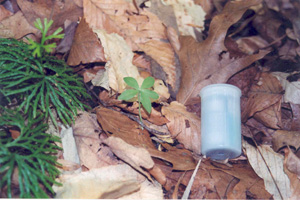
The small whorled pogonia, a tiny orchid (see
photo – note 35mm film canister for scale), is federally
listed as threatened and state listed as endangered. As a result,
it is protected by both federal and state endangered species
laws, and the U.S. Army Corps of Engineers (COE) and Virginia
Department of Environmental Quality (DEQ) must consider potential
impacts to this species before issuing permits to impact wetlands
and other jurisdictional waters.
Virginia counties with recorded colonies of the small whorled
pogonia include: Prince William, Stafford, Spotsylvania, Madison,
Caroline, Gloucester, James City, Lee and Wise. The highest
number of colonies have been found in Stafford and eastern Prince
William Counties. While, to the best of WSSI's knowledge, this
species has not been recorded in Fairfax or Loudoun Counties,
the recent discovery of this species in Madison, Lee, and Wise
counties indicates that it is not restricted to the Virginia
Coastal Plain and eastern Piedmont.
According to Kim Marbain of the U.S. Fish and Wildlife Service
(FWS), the FWS generally recommends that surveys be conducted
on any site within a county of known small whorled pogonia occurrence
if suitable habitat is present. In addition, at the request
of the FWS, the COE has in the past two years required small
whorled pogonia surveys on several sites in Fairfax County before
issuing Section 404 permits.
Preliminary (and relatively inexpensive) site evaluations to
determine whether potentially suitable habitat is present may
be conducted any time of the year; and for some sites, a habitat
evaluation may be all that is necessary to confirm absence of
the species. However, because above-ground structures (e.g.,
stems, leaves, and flowers) of the small whorled pogonia are
most apparent in late spring and summer, surveys for this species
in suitable habitat areas should be conducted between June 1
and July 20 (in Virginia localities from Caroline County north)
according to FWS guidelines.
Due to this limited survey "window", proper planning by project
proponents on sites having suitable habitat is critical. Failure
to have a pogonia survey conducted during the appropriate season
could potentially result in wetlands permitting delays of up
to a year! Therefore, project proponents of Virginia sites within
the species range that will require wetlands permitting should
also consider having a small whorled pogonia habitat evaluation
(or survey) conducted as early in the development process as
possible, preferably in the June 1-July 20 time frame, to ensure
development schedule compliance.
Plant Habitat and Characteristics
In Virginia, small whorled pogonias generally occur in fairly
standard-looking upland hardwood forests, usually dominated
by oaks, although it does show several habitat affinities that
allow for a more refined evaluation of habitat quality on a
given site. Most occupied sites occur on land that was cleared
for agriculture and farmed in the past, then allowed to return
to a forested state, with canopy trees approximately 40-80 years
old. Other characteristics common to most inhabited sites include
relatively open understory vegetation with sparse herbaceous
ground cover, and nearly level to gently sloping topography
with northern or eastern exposure. The presence of standing
dead trunks, decaying woody debris, sandy loam soils with low
nutrient content, and scattered gaps in the tree canopy are
also typical of occupied small whorled pogonia habitat.
The plant may grow up to 10 inches tall, but most individuals
are much smaller. They have five or six pale green leaves in
a whorl at the top of a smooth pale green stem. The small green
flower (usually one, occasionally two) sits atop the center
of this whorl of leaves, although in any given year, many (or
most) individuals in a colony do not produce any flowers.
Conducting an ETS Survey
Several other species, including the much more abundant and
widespread common whorled pogonia (Isotria verticillata)
and indian cucumber root (Medeoloa virginiana), can appear
very similar to the small whorled pogonia. Therefore, experience
is needed to distinguish individuals of these species. As a
result, FWS maintains a list of consultants and botanists with
sufficient experience conducting small whorled pogonia surveys
to reliably survey a site for this species.
WSSI has conducted a number of habitat evaluations and surveys
for the small whorled pogonia, and four of WSSI's scientists
are included on the FWS's list of small whorled pogonia survey
contacts.
For further information about this topic, or to have WSSI conduct
a small whorled pogonia habitat evaluation or survey on your
site, feel free to contact one of our scientists:
Steve Rottenborn, Ph.D. (srottenborn@wetlandstudies.com)
Craig Tumer, P.W.S. (ctumer@wetlandstudies.com)
Laura Giese, Ph.D., P.W.S., C.F. (lgiese@wetlandstudies.com)
Carrie Williams, W.P.I.T. (cwilliams@wetlandstudies.com)
Or you may reach any of our staff at (703) 631-5800.
|
|
 |
|